

Why Choose?

I've been thinking a lot lately about the roads we choose. Why this one and not that? Why this trip, now? Why did I ride 300 miles to the Steinbeck Center in Salinas last Saturday, and why – on the way back – did it make perfect sense to peel off the highway and head straight to Bruce's place for a feed?
Maybe it's instinct. Maybe it's a sense of obligation. Maybe it's something bigger nudging us when we're quiet enough to hear it. Or maybe it is because, at this stage of life, we're not so much chasing anything new as we are simply trying to understand where we're at. Making sense of it all. Feeling the weight of our own lives, no longer chasing conflict, and realizing some bags need to be unpacked. Not later. Now.
When I got the call to head over to Bruce's place, it wasn't a request. It was a signal. Subtle but unmistakable. Bruce had recently lost his wife of almost 36 years to cancer.
Grief like that doesn't follow a schedule. It lingers in the corners of the empty house long after the last casserole dish has been claimed and the neighbors have stopped knocking. When you've spent nearly forty years tethered to another soul, there's no manual for the silence that settles in. Footsteps on the wooden floor echo with a certain emptiness. The dog wanders around looking for something – for someone – who isn't there. It's not just absence – it's a shift in gravity, where even time behaves in odd ways, stretching and folding in on itself, trying to make sense of a life suddenly divided by 'before' and 'after.'
So, we do the best we can – we gather friends, we cook, we eat, we talk around it until the moment presents itself and someone finds a way to say what we're all thinking.
That evening, there weren't any big declarations. No unraveling of profound truth. Just food, shared space with a handful of close friends, and the sense that being there – fully, quietly – was enough. After all, sometimes, being a simple, quiet presence is the most important thing we can do.
After most of the group had gone, my friends Pat and Emma came to the house. It was a bit later than expected, but the timing felt right, as if the conversation had been waiting for its moment. And honestly, when did the hour of the day start mattering anyway? Shit! The wine was plentiful; there's always an old box of crackers in the cupboard and some kind of cheese in the fridge, but that wasn't what we gathered for. Pat started to talk, not in the polite, deflective way we sometimes use when life feels too complex to explain. He spoke from somewhere deeper. Somewhere worn down and honest. He talked about his childhood and his parents, especially growing up with the expectations of his mother, about teenage angst and pushing back. About the roles we're cast in as children and how often we don't question them until we're about halfway through life and starting to realize how much they've shaped us. He talked, and we listened. That was all he needed. That's all any of us really need sometimes – to be heard without interruption, without someone trying to fix us.
Pat's a medical sales director, incredibly successful, married to an equally accomplished medical professional named Alicia. Together, they've built a beautiful life and a loving family. On paper, everything about Pat's world suggests "resolved." But that night, I saw the other side – the cracks that don't show up in photos, the questions that don't get asked at board meetings, and the things that everybody wonders at some time or another but nobody dares speak about. The quiet fears that maybe we've repeated the same mistakes with our own kids that were made with us. Maybe we've parented from our wounds without even realizing it. The self-doubt that creeps in at strange hours and asks, "Did I really show up the way I thought I did?" The kind of doubt that clouds the mind when we can't sleep all night because we're worried – regardless of their age – about our children, who they're hanging out with, what they're doing, are they making good decisions, are they safe? God help us when none of it makes sense, and there are no apparent answers!
As a Psych, I hear these kinds of things from time to time when I'm with clients, but this was different. I was listening, processing, understanding – as a parent. These are questions we are all called to confront at some stage, and the only real resolution? "We've done our best." And honestly, we have!
Still, some questions linger. How do we pack for this thing called life? What baggage do we carry with us along the way? What do we shove into the corners of our suitcase – and how did half those things get there, anyway? And what do we leave behind? Some things we carry along by choice. Others – we don't get a say. But all of it comes with us, rattling around like an empty soda can that somehow found its way under the passenger seat, reminding you of something you meant to throw away but never did – only it's not just noise. It's a memory, a regret. The echo of a voice you wish you could forget, or maybe one you're terrified you never will. It bumps along with you, every mile, mile after mile, just beneath the surface.
It made me think about how I'd packed for my ride that morning. How trip preparation – real travel preparation for a long ride, like my pending trip to Sturgis – is a lot like emotional preparation. Motorcycles don't give you the luxury of overpacking. There's only so much room. You learn, sometimes the hard way, that what you carry has to matter. Everything you bring has to earn its place. And yet there I was, barely 20 miles out, freezing my proverbial ass off! 'So cold I'm pulling into a Tractor Supply Co. store to buy a long-sleeved shirt because I hadn't packed mine! I had too much of what I didn't need and not enough of what I actually did. It's such a simple moment – so minor you could almost miss it – but it hit me harder than expected. Because it wasn't just about a shirt; it was about the way so many of us still pack our lives.
We hold on to things out of habit, worried about how we'll look or come across to others. We prepare for journeys – whether physical or emotional – with assumptions, fears, old scripts. And we forget the basics. Warmth. Honesty. Openness. Sometimes, we're so worried about "being ready" that we bring everything except what actually keeps us safe and grounded. That moment on the bike, shivering through a cloudless California sunrise, I realized I was carrying things that didn't serve me, and I had left behind what mattered most for that moment. It's no different from life, is it? Our pasts, our traumas, our expectations – they crowd the saddlebags of our lives. And when we finally hit the road, we wonder why we feel heavy, cold, unprepared. We're not missing anything big. We're just missing the right things. And here's a news flash: Nobody else gives a damn about how you look; they're all too worried about themselves!
I have a lot of time to think when I'm on the bike – something about the road, the steady thump of a big V-Twin that's found its stride, it clears the static from your head, like life is finally quiet enough to hear yourself feel.
That short 300 miles reminded me of another journey. One that changed everything. My decision to move to the United States (America). That was a trip I prepared for over two long years. I built it up in my mind with every ounce of idealism and longing I had – that WAS my life!
Australia and America share much in common – language, entertainment, that rough-around-the-edges Western resilience. I thought the transition would be easy, even natural. It wasn't. Far from it – not even close!
In Australia, education is deeply respected. It's a sign of depth, of effort, of something enduring. In America, I found something I didn't expect – a wild, almost reckless sense of second chances. Here, people screw up and start again. And again. And again. And no one really bats an eye. There's something deeply human about that. Unvarnished. Forthright. In Australia, we hold tighter to expectations. There's more formality to how life unfolds. In America, failure isn't necessarily a red mark – it can be a badge of courage. That took time and effort to truly understand.
There were other differences, too – ones that snuck up on me in the aisles of grocery stores or quiet moments in conversation. Food quality, for example. In Australia, fresh produce, unprocessed meat, and chemical-free staples are more the default. Here in the States, you have to hunt for that. And when you do find it, it's expensive! I remember the first time I bought bread here and thought, What is this made of? I don't think I ever got an answer! (It didn't help that my father spent his life in the commercial bakery industry – a true connoisseur of 'real bread'!)
But the real shift – the one I didn't see coming – was internal. It was the birth of what I now describe as my time within the paradox of freedom. Before I arrived, I thought freedom was about options. About doing whatever you want, whenever you want. But that's not quite it. Real freedom, the kind that cracks you open, comes with consequences. With loneliness. With enormous responsibility. You realize no one's holding the map anymore. It's all you! And that power, that weight – it can be terrifying and liberating at the same time. With real freedom comes tremendous charge. For me, it came with a lot of anger and frustration, and a lot of asking, "Why?"…and a lot of healing over the years to come.
That's one of the main reasons that these days, I pack differently. I ask questions – not just about gear and routes and weather, but about what I'm really carrying into the next stretch of road. What are the thoughts that have expired, that no longer serve me but I'm still believing? What are the expectations I've inherited but never agreed to? What wounds am I still giving space to that should've been left behind a long time ago? When I pack light, the ride is smoother. When I carry what matters – truth, presence, trust – I find myself breathing easier. Quite literally. And not just on the bike!
Pat's story, the conversation, the glimpse of life that we all share stayed with me long after that night. Not because it was especially dramatic but because it was deeply familiar. We're all trying to figure out how we got here. We're all asking versions of the same question: Am I okay? Did I mess this up? Did I love well? What if I'd done this instead of that? Sometimes, those questions come late. Sometimes, they come on the back of a motorcycle somewhere between San Francisco and Salinas. They arrive when we're vulnerable enough to receive them and quiet enough to listen.
That's the real journey, isn't it? Not just the highway miles or the city signs flying past in our mirrors. It's the slow, steady reckoning with our own story and the melancholy of nostalgia. The small, often invisible acts of unpacking the unnecessary and reclaiming what was always essential. Some people do it in therapy. Some do it at a dinner table with old friends. Some do it silently, on a long ride with nothing but the wind in their face and the low rumble of the engine reminding them they're alive.
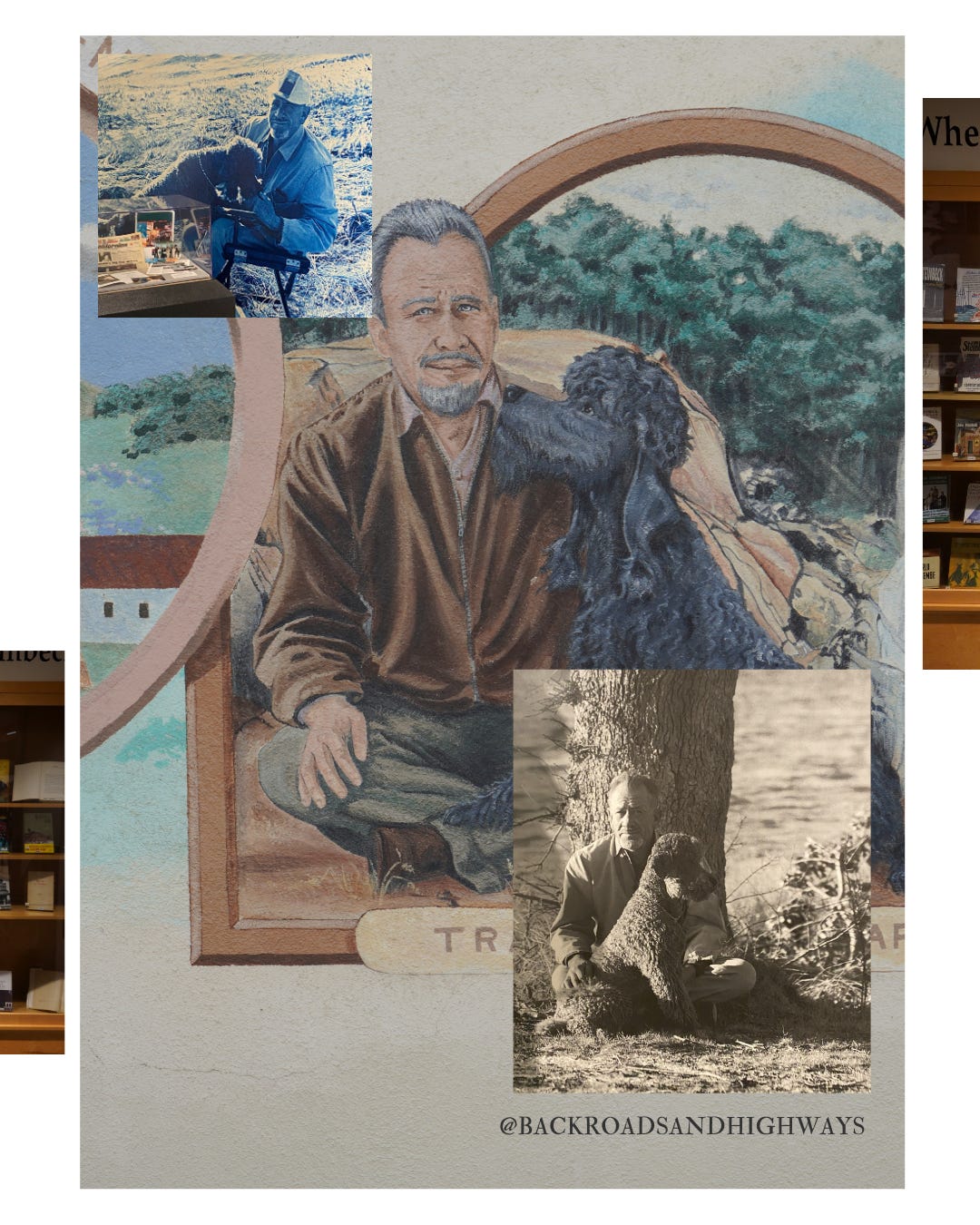
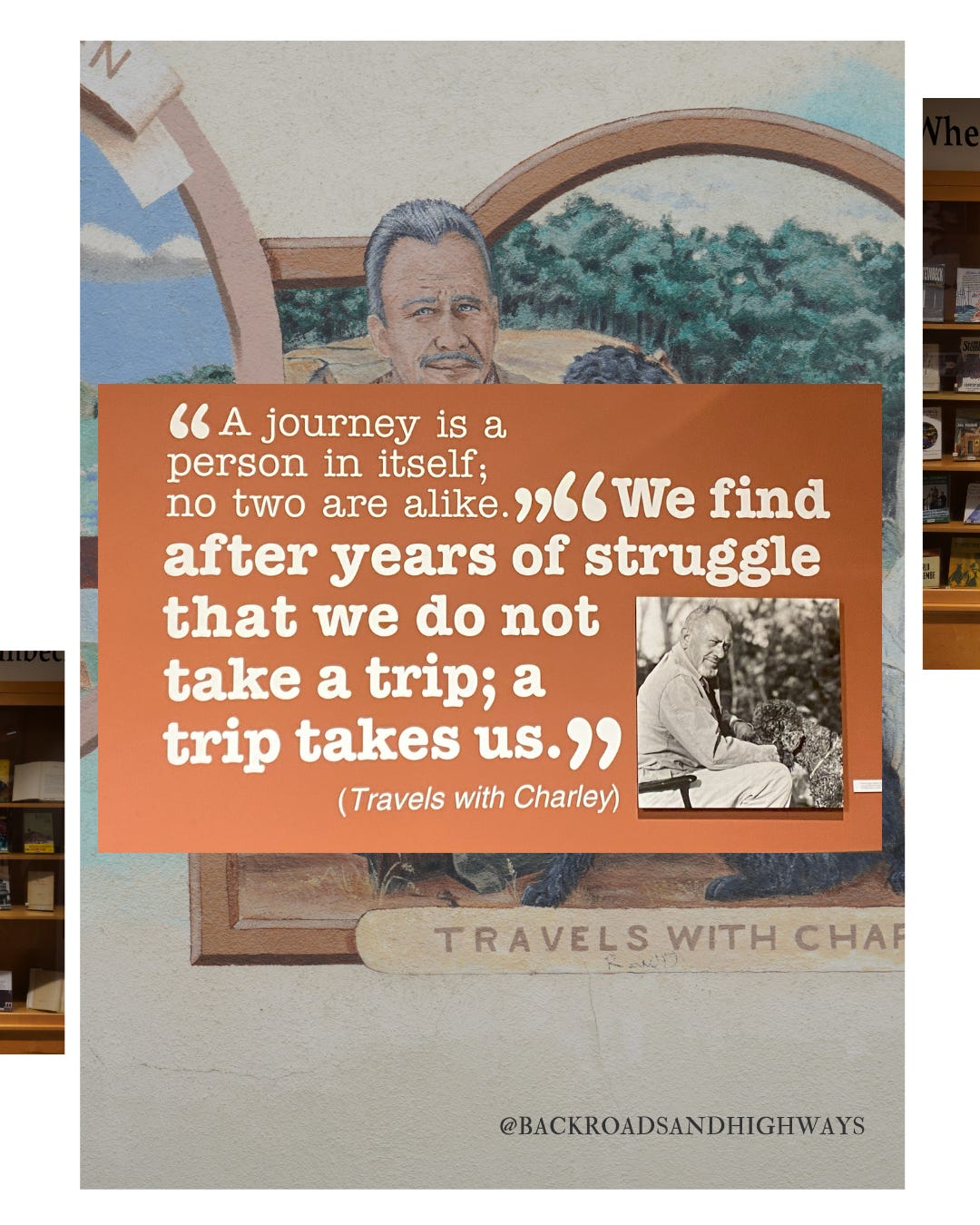
In 1960, John Steinbeck set out with his dog Charley to reconnect with an America he thought he no longer knew.
"What I'll get I need badly – a re-knowledge of my own country, of its speeches, its views, its attitudes and its changes…"
As they traveled around the country in their custom-built camper, Rocinante, he found …an America both familiar and foreign – changed by time, technology, and tension. In Travels with Charley, Steinbeck discovered a country grappling with the rise of consumerism, the fading of regional character, and the deep undercurrents of racial division, particularly in the South. Yet, he also encountered warmth, curiosity, and resilience in the everyday people he met along the way.
His journey wasn't just about the nation – it was about his own reckoning with age, identity, and purpose. What he found was a land in flux, a mirror of his own internal transformation, and a reminder that to understand a country, one must be willing to listen, observe, and travel with an open heart.
Can the same not be said for the journey we take within ourselves?
This isn't just a travelogue and the story of a guy on a Harley riding around the country; it's a kind of inventory. A way to track not just where I go but how I go. How I show up. What I carry. What I'm willing to leave behind – and who I get to meet and talk with along the way. That's what trip preparation is for me now. It is not a checklist but a practice in awareness. It's where the real journey begins.
And if we're lucky – if we're really lucky – we get to travel a little lighter next time.
What are you packing for your travels
?