

The Road to Remembering

It's a funny thing, the way our lives are shaped – and the things along the way that shape them. Not all at once, and not by some grand sweeping choice like the heroes in books get to make. No – more often, it's a thousand tiny decisions stitched together like the seams in a well-worn coat. Most of them, at the time, seem small. Insignificant even. But some… some stand the test of time and memory. Some you can trace with your finger, even years later, like the old and worn trails on a map or some long-abandoned highway.
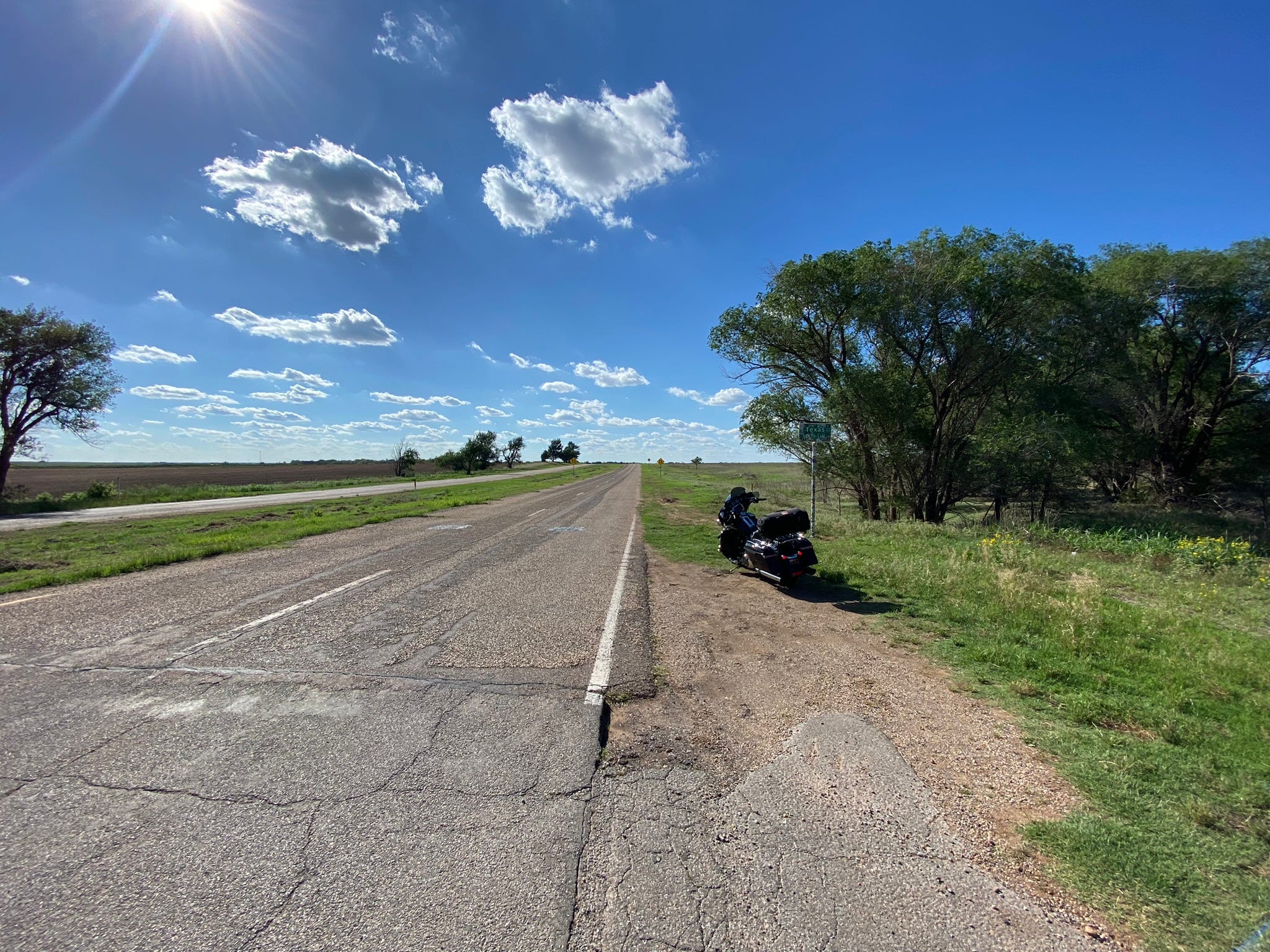
Oklahoma-Texas State Line heading west … Route 66
But even those old highways seem to remember you – every turn, every gas station ghost, every dusk you watch sink behind a dying neon sign. They carry your weight long after you've gone. They carry you forward toward a changing, modern reality. Like a scar that never quite healed, like the echo of a goodbye you never fully said, a place you've grown up in but still don't feel a part of. Driving down those old roads, the nostalgia doesn't arrive in grand declarations – it slips in quietly like the way old songs find you in diners that haven't changed the jukebox since 1978. It settles into the silence between mile markers, tugging at your sleeve when the light softens just right, reminding you of who you were before the world got loud. You're not chasing memories – you're tracing the remnants, the outline of something that once made sense.
It's not about missing what was, exactly, but the ache of having been someone else in a place that didn't ask questions and where the word 'respect' meant something. The old roads don't haunt you; they hum beneath your skin. A low, familiar frequency that reminds you freedom always comes with a cost, and sometimes that cost is never being able to go back – not really. Not ever! You drive or ride it again, not to remember, but to be remembered.
I ride those old highways to revisit some of those decisions, some of those dreams, some of the wishes I made, and conclusions I reached when I was younger – to see if they still hold water today. For me, one of those moments, one of those things I have wondered about, came when I was somewhere around thirteen years old.
The year was 1982. Ronald Reagan occupied the office of the President, nuclear war hung like a storm cloud on the horizon, and every other kid I knew was more worried about their locker combination than the world ending in a flash of light. One of the memories I have from my much younger years was seeing the horrors and consequences of the Vietnam War every night, which often led the six o'clock news. The Cold War was a distant kind of thing you could feel in your bones if you were paying attention – but even as a kid, I had a habit of 'paying attention!' There was an unspoken, strange kind of anxiety in the air like everybody was holding their breath and trying not to make too much noise.
I remember thinking – not with fear exactly, but with a kind of steely acceptance – that the world might very well blow itself up. And if it did, I didn't want to leave this life without having decided what kind of person I was going to be. It's a heavy thought for a thirteen-year-old, but I wasn't alone in it. I think all kids, in their own maybe secret way, start building their moral houses around that age. The biggest influence on our small and sheltered world at that time had to have been the music we listened to – the lyrics that became high school anthems: the Sex Pistols, X-Ray Spex, Siouxsie and the Banshees, Dead Kennedys, The Who. Bands that grew up out of the rebellion of the '60s and '70s, finding a strange kind of comfort in the genre of Punk Rock – itself an uprising against the commercialism and excess of mainstream 'fluff.' We were rejecting everything from corporate culture and its values to the acceptable, choking, wide-lapel, white-loafer attire popular at the time.
Some of us built our houses with bricks of rebellion, some with silence, some with dreams bigger than their town could hold.
I decided mine would be built on honesty – brutal honesty! My truth!
Not the kind of honesty you shout to win arguments or the kind you wield like a sword. No – I wanted to be open. Genuine. To speak what was true, even if my voice shook. Even if there was a price to pay – and it inevitably would always cost me something!
Maybe you're reading this and have already decided that as a response to the age and atmosphere of the times, this was just another way of rebelling. But it became ingrained, and it stuck. Maybe today, I'd call it by name – a character trait: authenticity. Even today, you know where you stand with me. Back then, it just felt like the only real choice I had if I wanted to keep moving forward.
It sounds all very noble when I put it like that. But in practice, thirteen-year-old honesty was an absolute mess!
I learned quickly that speaking the truth – especially the truths nobody asked for – is not a well-paved road to popularity. It got me detention a few times. Once for correcting a teacher whom I believed was just a little too casual with historical facts, and another time for answering a rhetorical question a little 'too honestly.' Yeah – I was good at that!
What I remember most from that period wasn't the detention. It was the silence that followed when the truth dropped into the room. The feeling that I had cracked some invisible mirror, and now everyone could see the jagged lines.
Adults didn't quite know what to make of me. Rumors spun up like tumbleweeds – that I was a troublemaker, a rebel without a cause – maybe I was even doing drugs! Some assumed I was another angry young man trying to find his place in the world. Others thought I was just looking for attention. But it wasn't rebellion, not really. I wasn't trying to tear anything down. I was trying to build something – even if I didn't have the words for it yet.
I was trying to live by the deal I had made with myself.
I think about that kid sometimes – the earnestness of him, the absolute awkwardness too. The way he stumbled over the right words, the way he often spoke without quite knowing how the truth would land. But he kept at it, and in a strange sort of way, every time it hurt – every time honesty cost me a seat at the lunch table or an 'atta boy – it strengthened something inside me.
There's a kind of muscle to living honestly. At first, it's weak and wobbly, and it embarrasses you more than impresses anyone else. But just like any other kind of exercise, it grows if you keep at it.
When people talk about authenticity, it's usually dressed up in a way that makes it sound easy. "Be yourself!" they say, as if there aren't a thousand quiet reasons every day to be someone else instead.
The truth is, authenticity is a risk. It's a kind of gamble we take with the world.
It's standing there – no armor, no script – and trusting that even if you're misunderstood, even if you're rejected, the person you're choosing to be matters more than the approval you're losing.
At thirteen, I didn't have the sophistication to package my honesty nicely. It was rough-edged and sometimes clumsy. But it was real. And if there's anything I've learned since, it's that real matters more than perfect.
The world doesn't always reward honesty. Sometimes, it punishes it. Sometimes, it laughs at it or twists it into something ugly. But underneath all that, there's a quiet kind of respect that grows – not from others, necessarily, but from yourself. In every conversation, there's a quiet moment – a crossroads – where you decide whether to speak from ego or empathy. Honesty, in its truest form, isn't just about saying what's real; it's about saying what's real with care. Something deep inside yourself that knows the difference between being honest to hurt and being honest to heal – and chooses the latter out of respect.
You know who you are. And that's worth more than fitting in. It's not your responsibility to be a version of you that puts other people at ease.
More than forty years later, I find myself asking: does it still hold water?
Have I stayed true to the deal I made with myself back then?
The answer is both simpler and more complicated than an innocent 'yes' or 'no.'
I have learned – sometimes painfully – that honesty without kindness is only often cruelty in disguise. And kindness without honesty is no better! Speaking the truth doesn't always mean speaking every truth, especially when it's not yours to tell.
I've learned the value of timing, of listening first, of asking whether the truth I'm about to speak will build or break. But I have also learned that there are certain things – certain non-negotiables – that it's better to be upfront and open about, not to harbor ill-wills that fester and daylight into contempt, disdain, and ultimately regret. It is often a fine line drawn by experience and time.
But at the core, the boy who decided to live openly – to live as himself – is still here.
He's just grown into a man who understands that authenticity isn't a bludgeon; it's a compass. It doesn't excuse you from hurting people; it challenges you to be courageous enough to care how your truth lands. It doesn't mean you shout your every feeling into the void; it means you don't betray yourself for comfort or applause.
And when the road splits, when shadows stretch long, and the ego whispers louder than grace, it's that compass – the quiet pull of the soul – that turns him inward. It doesn't promise clarity, only alignment. Not certainty, but presence. He's learned that the path isn't paved by righteousness but by resonance, and when he screws it up, he owns it. That truth, when spoken with reverence, doesn't just clear the air – it sanctifies the moment. And when he drifts, as all wanderers do, it's not shame that brings him back but the sacred ache of disconnection. That holy discomfort that says, “This isn't who you are. Come home. Choose again” – with a heart wide open and spirit intact.
That's how a man stays honest. That's how he knows he's still himself.
And maybe that's what remembering is – not living in the past but carrying forward the best promises we made when we were too young to know how hard they'd be to keep.
If you walk into any small-town schoolyard, or sit quietly in the corner of a fast-food restaurant where teenagers gather, or listen to the low, urgent voices at a gas station on the edge of nowhere, you'll hear it. The sound of young people deciding who they will be.
Most of them don't even know they're doing it. Some will take longer than others. Some will forget for a while, lose their way, get hurt, toughen up too much – and soften again. I did. But all of them are laying bricks – stacking up the selves they will someday have to answer to.
It's a story about me. But it's a story about you, too. About all of us. We all have that moment – or a string of moments – where we sit with ourselves, quietly, or not so quietly, and choose.
Choose to tell the truth or tell a story. Choose to stand up or to shrink down. Choose to live for the approval of others or for the peace in our own hearts.
And even when we forget – even when life knocks us around, or fear seduces us into smallness – there's a road back. There's always a road back.
It's the road to remembering.
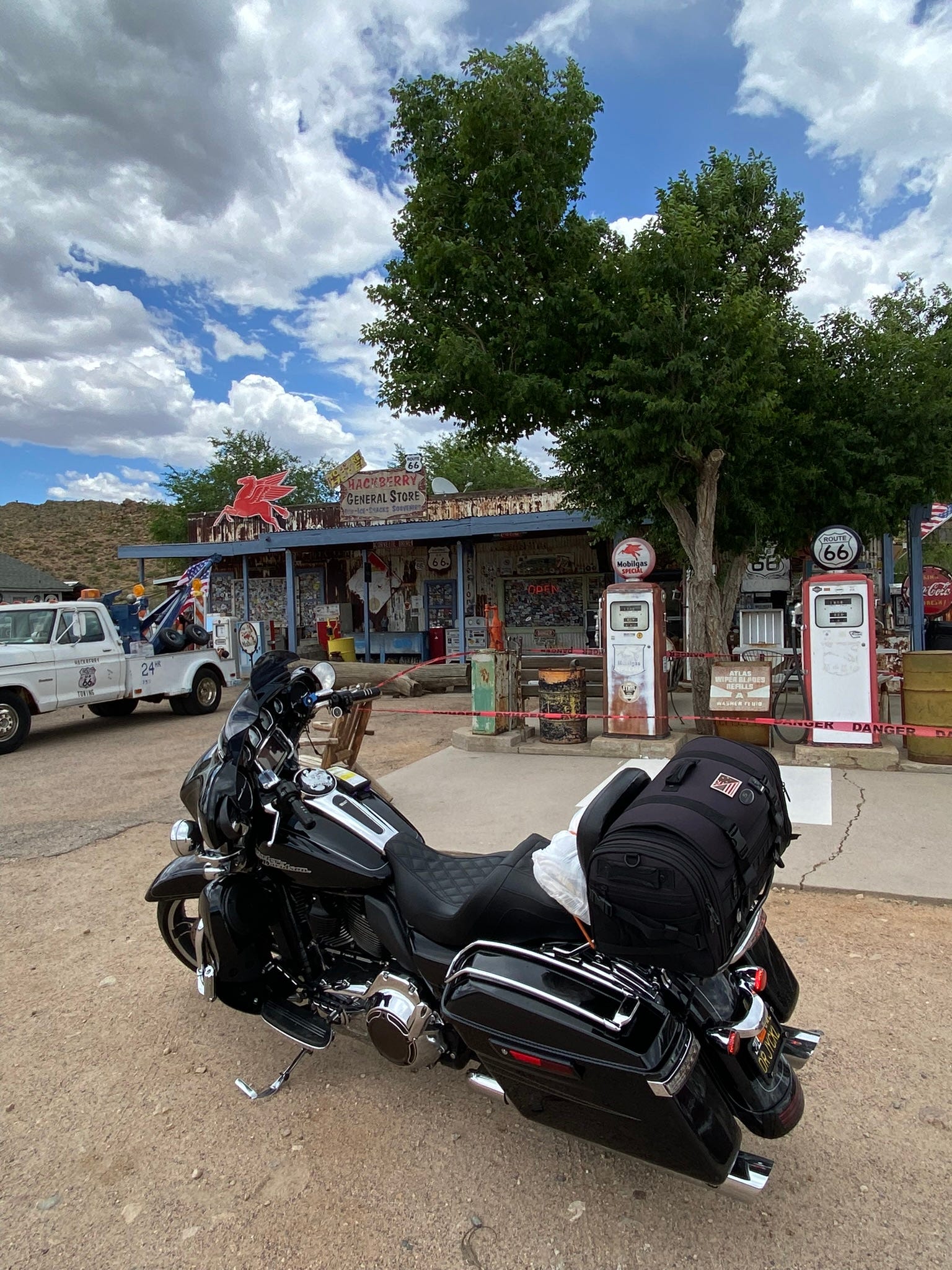
Taking a break. Hackberry General Store, Mohave County, AZ … Route 66
When I ride the Old Road, it's not just an old, abandoned highway, it's a quiet testament to what once was – a stretch of pavement that carries more stories than miles. It beckons not with the promise of destinations but with the pull of something deeper, a feeling that isn't always easy to name. It's a byway where the past lingers, not in dusty relics, but in the way the landscape unfolds like an old letter – doubled over and overlapping, faded, and yet somehow still legible. To ride it is to acknowledge that some things are meant to fade into memory but never truly disappear. It's a journey through the spaces between what we left behind and the places we'll never quite reach – the way we see ourselves in the mirror of time, the way we always wanted to be.
And if you find yourself a little lost these days, wondering whether you're still the person you set out to be, you're not alone.
The good news is the road is still there. It's still waiting. And you can still choose it, no matter how far you've run or how many detours you've taken.
Because when you return, it's not to relive the past, but to touch something that still remembers how you once believed you might outrun yourself.
Perhaps I'll see you out there sometime? Pull up and say hello!